RETURN TO HOME PAGE
Building on In-fill Lots
Working on a small lot with existing neighbours
Raising a house on an urban building lot where a house existed earlier and with neighbours on all sides is not an attractive situation for most builders. However, there are strategies for overcoming the many challenges presented by such sites.
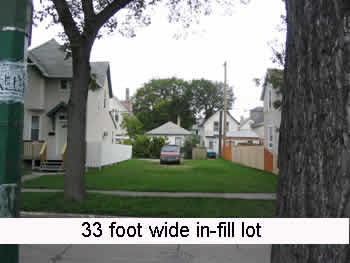 In a nutshell, these are the kinds of problems that come with an urban in-fill lot:
- the builder only has the use of the width and depth of the lot and no extra space for moving equipment, storing materials, moving or manoeuvring sections of the building - management of space on the lot is critical
- large vehicles (like concrete delivery trucks) can generally use the front street, but parked cars can obstruct the area in front of the site, boulevard trees can obstruct loading arms and concrete pump equipment, and regular traffic cannot be affected activity related to the building work
- all-day parking for the builder's vehicles and trailers can be costly, inconvenient, or nonexistent. Parking on the building site uses up valuable space needed for other uses
- chain-link fencing is generally needed to keep the public from coming into harms way and to protect tools and materials. This fencing has to be opened and closed for all deliveries, parking, etc.and it is an added cost not typically needed on other types of sites
- digging a full basement will result in moving soil right up to the neighbours' foundation walls. If problems occur with those neighbouring walls in the future, is the builder of the in-fill house at fault?
- if a house existed on the site before, are there still parts of the foundation below the surface? How well was the site cleaned up when the original house was removed?
- any excavation work will result in pile of earth that is surprisingly large. Regardless of where it is placed, the pile will be in the way for some future aspect of the work. Removing it is an added expense, and a portion of it may be needed later for back filling.
- the existence of a previous foundation system or basement means that the first 6 to 8 feet of soil depth has been disturbed. Engineering advice will suggest that any new foundation system cannot use that disturbed soil for bearing - the builder must start at the level of the undisturbed soil
- activity on the site will have to fit into the neighbourhood routine - excessive noise or activity early in the morning or into the evening will not be appreciated
- the house size and exterior appearance tend to be limited by the surrounding homes - building a home that is much larger or much smaller than its neighbours will look odd, and very modern design elements look out of place in an older neighbourhood
Advanced Design/Build Inc. found solutions to all these problems in order to complete the West Broadway Healthy House project.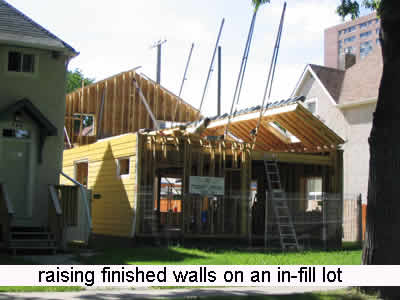 A two storey home of 1800 square feet was built on a lot measuring 33 feet wide. A concrete pump unit was needed to place the concrete for the pile and slab main floor, working from the front street. We pre-built wall components and used the concept of 'raising finished walls' which allows a small crew to lift a long wall that is sheathed and has the finished siding already applied. The use of air nailers was minimized to maintain the quietest possible work site until the work moved indoors. Most of the materials for the home were brought in using a 3/4 ton truck, typically bringing a day's worth of materials so that no loose materials were left on the site a night. Parking permits were required for vehicles on the front street more than one hour, and the back lane access was limited by 2 right angle corners in the lane way. In terms of site access, this was probably as severe as one would encounter in any urban building project.
RETURN TO HOME PAGE
Home ■ Swedish Bldg Model ■ What Kind for Prairies ■ Handicapped Access ■ In-Fill Lots ■ Water Management ■ Ongoing Debates ■ Contact Us
Projects: Lount Lodge ■ YMCA Camp Stephens Water System ■ WBDC Healthy House ■ Weir Residence ■ Caron House
Teaching Projects: CMHC and Davis Inlet Housing ■ Community Sawmill Training
The Company We Keep: Sunergy Systems Ltd. ■ Architectural and Community Planning Inc. ■ Crosier Kilgour ■ McMunn and Yates